- Home
- Free guides
- Study
How to Study for Exams Without Forgetting: 6 Study Tips That Really Work
The two habits that improve marks most are active recall (close the book and write what you remember) and spaced revision on days 1, 3, 7 and 21. Add 45–50 minute study blocks, a mistake log and timed past papers.
- Re-reading feels easy but doesn't make memories last – test yourself.
- Revise on days 1, 3, 7 and 21.
- Practise past papers with a timer and keep a mistake log.
Studied for hours and still went blank in the exam? These study tips for students fix the real problem: we practise recognising, but exams test recalling.
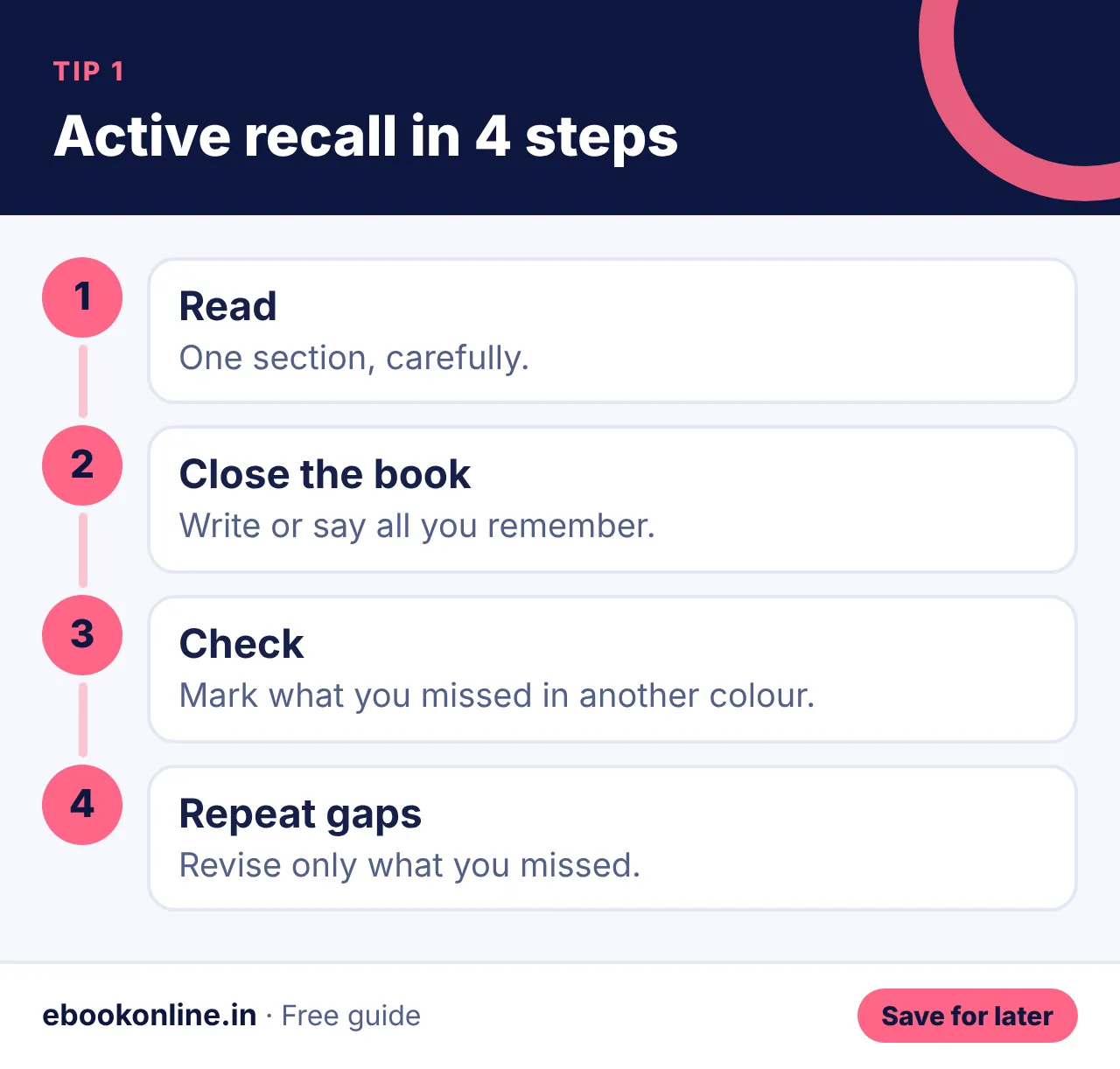
Tip 1: Use active recall, not re-reading
Show as text
- Read a section once, carefully.
- Close the book. Write or say everything you remember.
- Open and check. Mark what you missed in another colour.
- Repeat only the gaps.
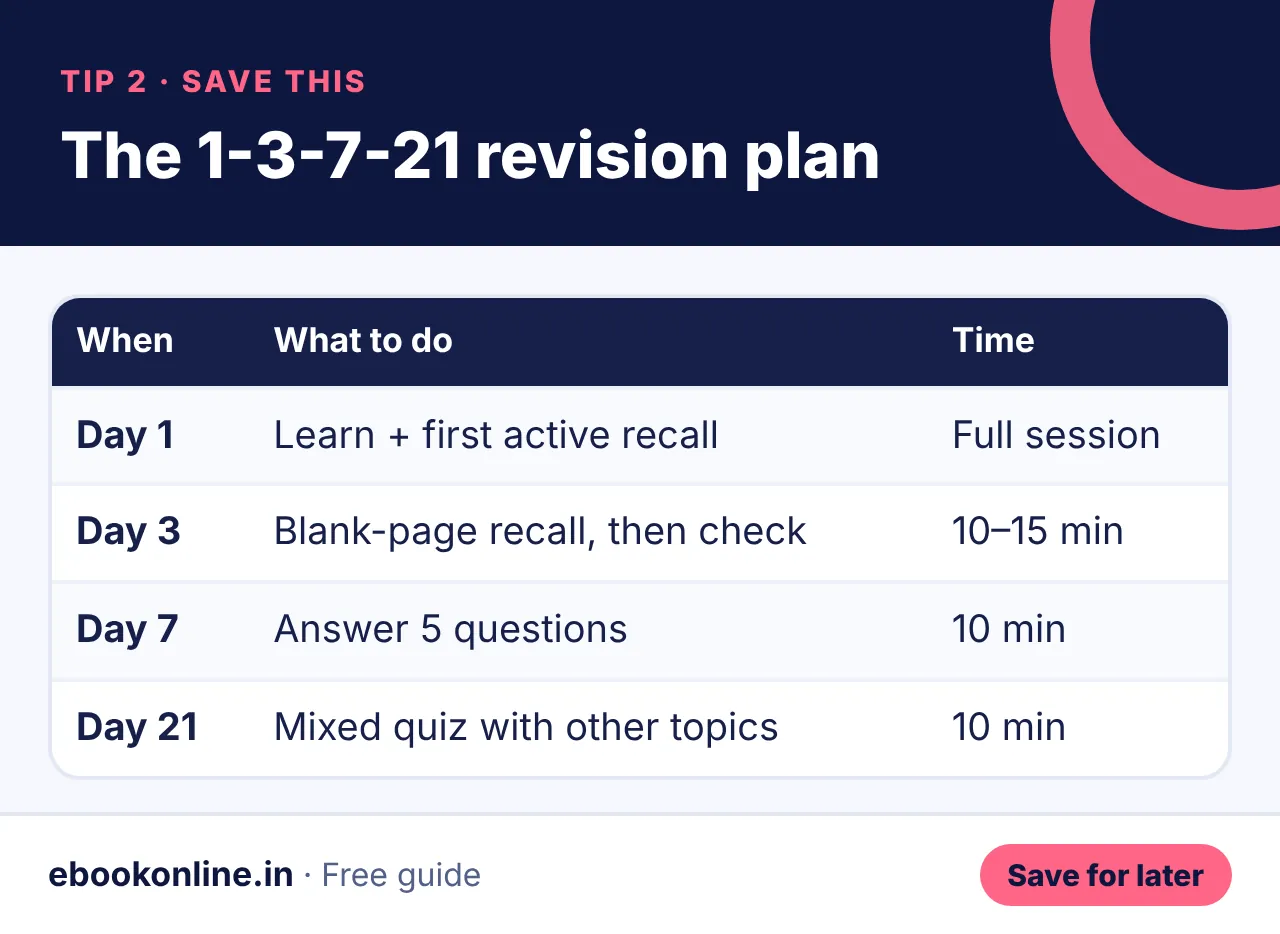
Tip 2: Revise on days 1, 3, 7 and 21
Show as text
| When | What to do | Time |
|---|---|---|
| Day 1 | Learn + first active recall | Full session |
| Day 3 | Blank-page recall, then check | 10–15 min |
| Day 7 | Answer 5 questions on the topic | 10 min |
| Day 21 | Mixed quiz with other topics | 10 min |
After your next study session, close the book and write everything you remember on a blank page for 5 minutes.
Tip 3: Make a timetable that survives real life
- Plan from the time you really have.
- Write specific tasks ("Chapter 4: 10 numericals"), not just subjects.
- Study in 45–50 minute blocks with real breaks.
- Keep your phone in another room while studying.
Tip 4: Practise the exam, not just the reading
Solve past papers with a timer. Write every mistake in a "mistake log" – careless and time mistakes are the fastest marks to win back.
Use AI the right way with our ChatGPT prompts for students, and look after your energy with simple healthy habits.
Tip 5: Make notes that test you
Use the Cornell method: a narrow left column for questions, a wide right column for notes, and a short summary at the bottom. Later, cover the right side and answer the questions.
Tip 6: Follow an exam-day strategy
- Sleep well and eat breakfast.
- Read the whole paper first and plan time per mark.
- Do the easy questions first.
- Keep 10 minutes at the end to check.
Pick the right study apps from AI tools for students. Take a 15-minute movement break with our yoga routine for beginners. More: Career & Money eBooks.
A look inside the eBook: Study Smarter
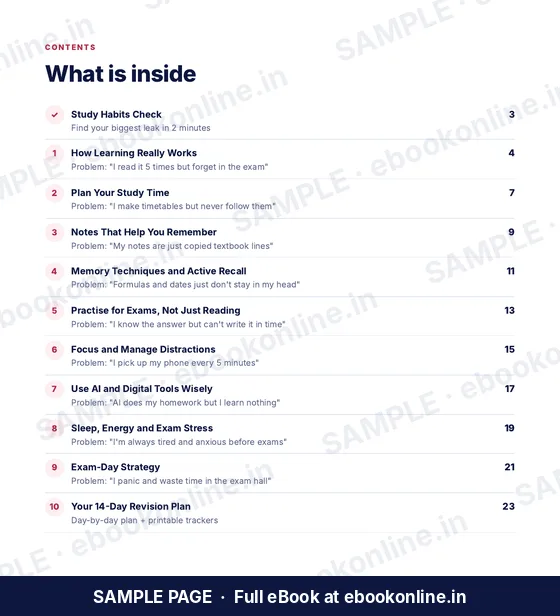
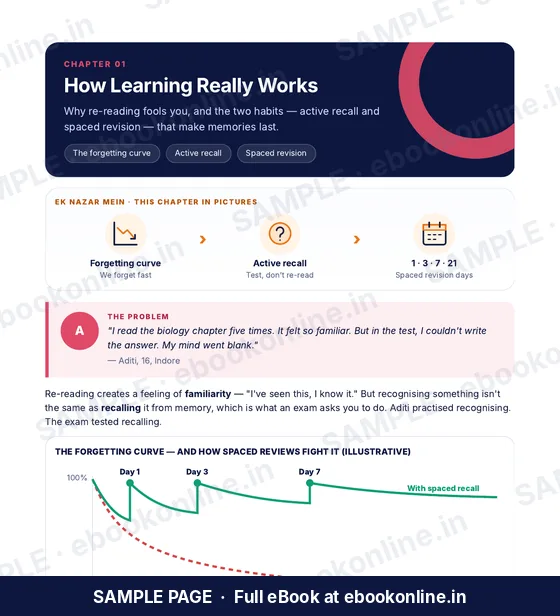
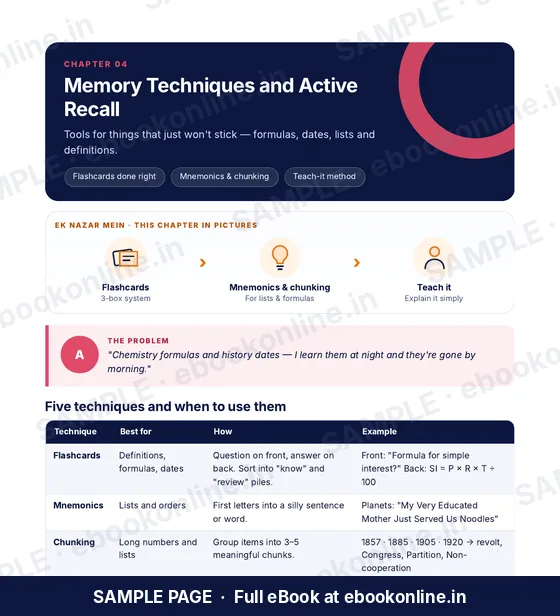
This article covers the basics. The full eBook goes step by step – these are real sample pages from the 25-page PDF. Tap any page to see it bigger.
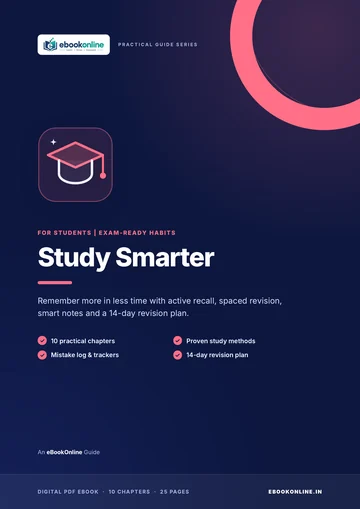
What you get for ₹99
- 10 chapters on how learning really works
- Notes, memory techniques and active recall
- Focus, sleep and exam stress
- Exam-day strategy and a 14-day revision plan
- 25-page PDF · read on phone or print at home · instant download after payment
Coming soon.
Frequently asked questions
What is the best way to study for exams?
Use active recall and spaced revision, practise past papers with a timer, and keep a mistake log.
How many hours should a Class 10 student study?
Focus on quality: 3–5 focused hours a day before exams is common, in 45–50 minute blocks with breaks. Adjust to your school schedule.
Why do I forget what I study?
Memory fades quickly unless you recall it again. Reviewing on days 1, 3, 7 and 21 slows forgetting.
Is studying at night good?
Studying late now and then is fine, but regular sleep helps memory. Avoid all-nighters before exams.
How do I stop using my phone while studying?
Keep it in another room during 45–50 minute study blocks and check it only in breaks.