- Home
- Free guides
- Money
50/30/20 Budget Rule – How to Plan Your Monthly Salary (India)
Salary comes, and by the 20th it is gone? The 50/30/20 budget rule is a simple way to split your income so bills are paid, you still enjoy life, and some money is saved every month.
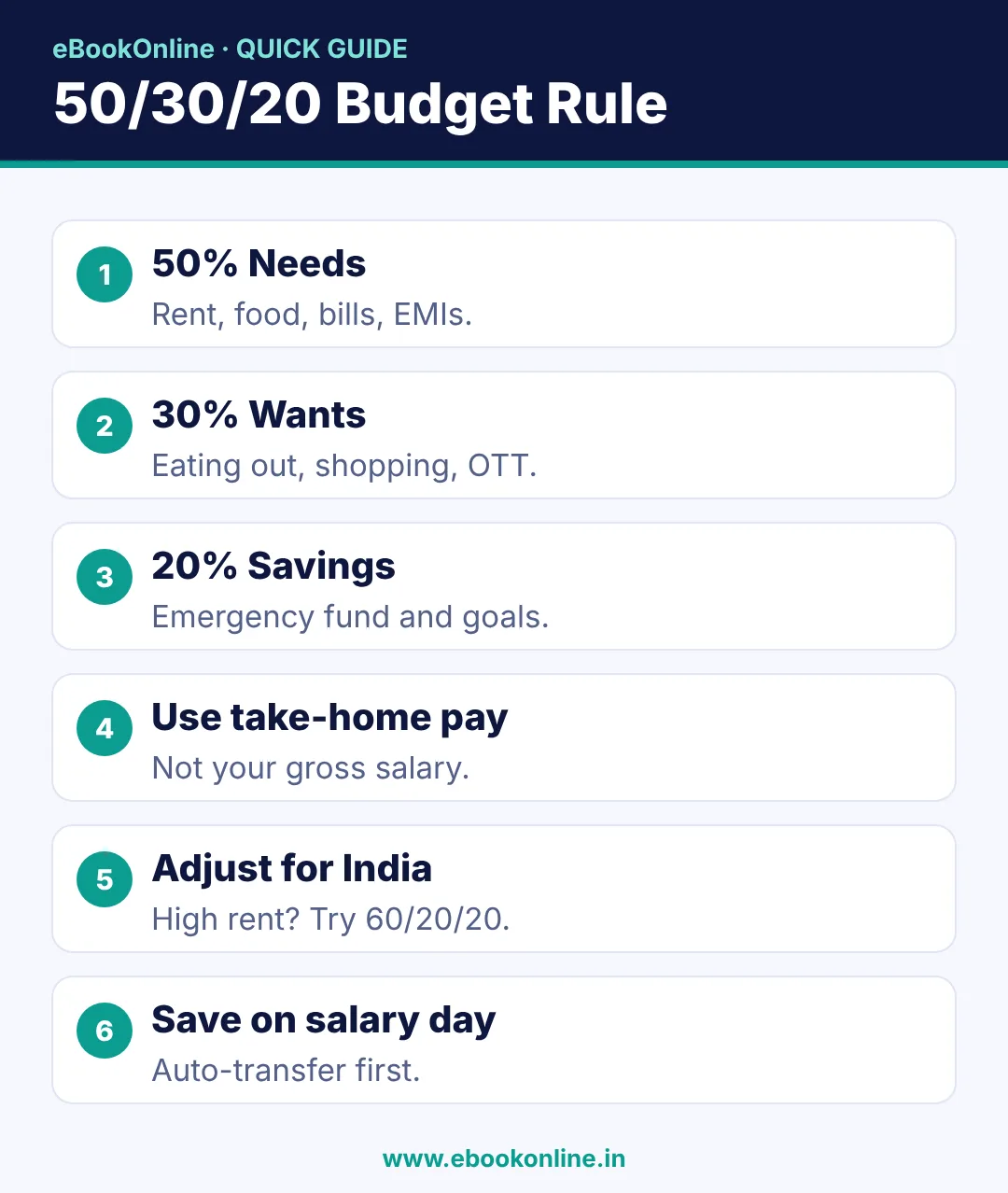
- 50% of take-home pay for needs (rent, food, bills, EMIs).
- 30% for wants (eating out, shopping, OTT, trips).
- 20% for savings and goals – move it on salary day, before spending.
Most people don't have a money problem, they have a planning problem. Without a plan, small spends on food delivery, shopping and subscriptions eat up the salary. The 50/30/20 budget rule is one of the easiest ways to plan. It gives every rupee a job and needs no complicated spreadsheet.
This article is for general education. For investment or tax decisions about your own situation, speak to a qualified or SEBI-registered adviser.
What is the 50/30/20 budget rule?
You divide your take-home income (after tax and PF) into three parts:
| Part | Share | What it covers |
|---|---|---|
| Needs | 50% | Rent, groceries, electricity, phone, travel to work, school fees, EMIs, insurance |
| Wants | 30% | Eating out, shopping, OTT, gadgets, trips, gifts |
| Savings | 20% | Emergency fund, goals, investments, extra loan repayment |
The idea is simple: needs are paid, life is still enjoyable, and you save regularly.
Take your monthly take-home salary and multiply by 0.2. Set an auto-transfer of that amount to a separate savings account on salary day.
50/30/20 budget rule examples with Indian salaries
| Take-home salary | Needs (50%) | Wants (30%) | Savings (20%) |
|---|---|---|---|
| ₹20,000 | ₹10,000 | ₹6,000 | ₹4,000 |
| ₹30,000 | ₹15,000 | ₹9,000 | ₹6,000 |
| ₹50,000 | ₹25,000 | ₹15,000 | ₹10,000 |
| ₹75,000 | ₹37,500 | ₹22,500 | ₹15,000 |
To calculate quickly: multiply your salary by 0.5, 0.3 and 0.2.
Needs vs wants: how to decide
Ask: "If I stop this for 3 months, will my life or job be affected?"
- Need: rent, basic groceries, school fees, medicines, work travel, loan EMIs, health insurance.
- Want: food delivery, branded clothes, new phone before the old one stops working, weekend trips, premium subscriptions.
Some items are half and half. A basic phone plan is a need; an expensive unlimited plan with OTT add-ons is partly a want.
How to adjust the rule for Indian life
The rule is a starting point, not a law. Adjust it to your life:
- High rent in a metro city: try 60/20/20 – cut wants, protect savings.
- Small income: try 70/20/10 – even 10% savings builds the habit.
- Big EMIs: keep EMIs inside "needs" and aim to keep total EMIs under about 30–40% of take-home pay. Use part of wants for faster repayment.
- Living with parents, low expenses: try 40/20/40 and save more while you can.
- Irregular income (freelance, business): budget on your lowest month's income and save the extra in good months.
How to start in 5 steps
- Find your real take-home pay – the amount that reaches your bank.
- List last month's spends from your UPI and bank app. Mark each as need, want or saving.
- Set the three limits using the table above.
- Pay yourself first: on salary day, auto-transfer the 20% to a separate savings account.
- Track weekly: spend 10 minutes every Sunday checking where you stand.
You can make a simple tracker in Excel with SUM formulas – our Excel formulas list shows how.
Where should the 20% go?
A common order people follow:
- Emergency fund – first build 3–6 months of essential expenses.
- Health and term insurance – if you have dependants.
- High-interest debt – clear credit card dues and costly loans.
- Goals – education, house, retirement, based on your time and risk comfort.
The right products depend on your situation, so read official information and speak to a SEBI-registered adviser before investing.
Tips to make it work
- Cut one big want instead of many small ones – for example, cook at home on weekdays. Our budget meal plan helps.
- Cancel unused subscriptions every 3 months.
- Use cash or a separate UPI account for "wants" so you see the limit.
- Read more ideas in money saving tips for students and homemakers.
Common mistakes
- Using gross salary instead of take-home pay.
- Saving "whatever is left" at month-end – usually nothing is left.
- Being too strict and giving up after one month. Small, steady progress is better.
A look inside the eBook: 30 Days to Save Money Every Month
This article covers the basics. The full eBook goes step by step – these are real sample pages from the 35-page PDF. Tap any page to see it bigger.




What you get for ₹99
- 10 chapters: budget, emergency fund and saving goals
- Getting out of costly debt and basic insurance
- Investing ideas without the hype
- Scam protection and money with irregular income
- 35-page PDF · read on phone or print at home · instant download after payment
Coming soon.
Frequently asked questions
What is the 50/30/20 rule in simple words?
Spend 50% of your take-home pay on needs, 30% on wants and save 20%. It is a simple way to plan your monthly budget.
Is the 50/30/20 rule good for India?
Yes, as a starting point. In metro cities with high rent, many people use 60/20/20 or 70/20/10 and adjust as income grows.
Do EMIs come under needs or wants?
Loan EMIs usually go under needs because they must be paid. Try to keep total EMIs under about 30–40% of take-home pay.
What if I can't save 20%?
Start with 5–10% and increase slowly. The habit matters more than the exact number at the start.
Where should I keep my savings?
First build an emergency fund in a safe, easy-to-access place. For investments, read official sources and consult a SEBI-registered adviser.