- Home
- Free guides
- Money
How Much Emergency Fund Should You Have? Simple Guide for India
Job loss, a hospital bill or a sudden repair can come without warning. An emergency fund is money kept aside for exactly these moments. Here is how much emergency fund you should have and how to build it.
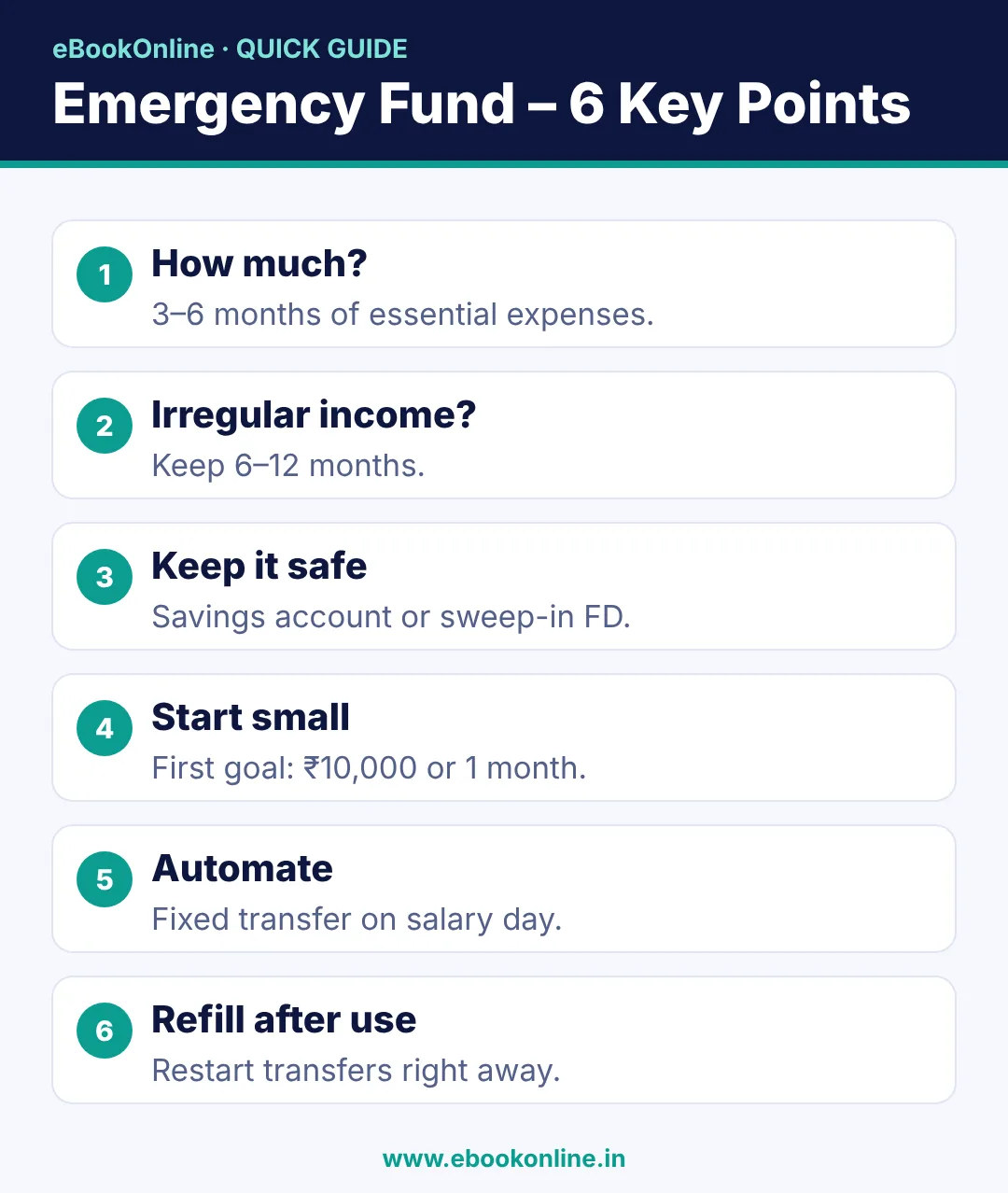
- Keep 3–6 months of essential expenses; 6–12 months if income is irregular or you are the only earner.
- Keep it safe and easy to withdraw, separate from your daily account.
- Build it slowly with a fixed monthly transfer, and refill it after using it.
An emergency fund is money you keep aside only for real emergencies – not for shopping, trips or a new phone. It protects you from taking costly loans or using a credit card when life surprises you. This guide explains how much emergency fund you should have, where people usually keep it, and how to build it even on a small salary.
This article is for general education only. For decisions about your own money, speak to a qualified or SEBI-registered adviser.
What counts as an emergency?
- Job loss or salary delay
- Medical emergency not fully covered by insurance
- Urgent home or vehicle repair
- Sudden travel for a family emergency
Not emergencies: sales, festivals, gadgets, holidays, weddings you knew about months ago. Plan those as separate goals.
Add up this month's essential expenses: rent, food, bills, EMIs, school fees. Multiply by 3. That is your first emergency fund target.
How much emergency fund should you have?
A common rule is 3 to 6 months of essential expenses. Essential expenses are what you must pay even in a bad month: rent, groceries, electricity, phone, EMIs, insurance premiums, school fees and medicines.
| Your situation | Suggested emergency fund |
|---|---|
| Stable salaried job, two earners at home | 3–4 months of expenses |
| Salaried, single earner with family | 6 months |
| Freelancer, business owner, commission income | 6–12 months |
| Student or living with parents | 1–3 months of personal expenses |
Example
If your essential monthly expenses are ₹25,000:
- 3 months = ₹75,000
- 6 months = ₹1,50,000
Don't worry if the number looks big. You build it step by step.
Where to keep your emergency fund
An emergency fund needs to be safe and quick to withdraw. Earning high returns is not its job. Options people commonly use:
| Option | Access | Notes |
|---|---|---|
| Separate savings account | Instant | Simplest; keep it in a different bank from daily spending if you can |
| Fixed deposit with sweep-in / auto-sweep | Quick | Extra money moves to FD and comes back when needed |
| Short-term FD | 1–2 days (may have penalty) | Good for part of the fund |
| Liquid mutual funds | Usually 1 working day | Market-linked with low risk, but not a bank deposit; read the scheme details |
Many people keep about one month's expenses in a savings account for instant use and the rest in sweep-in FDs or similar options. Avoid keeping the emergency fund in stocks, crypto or anything that can fall sharply or takes long to sell.
How to build your emergency fund step by step
- Calculate your target using the table above.
- Start with a small first goal – ₹10,000 or one month of expenses.
- Open a separate account so you don't spend it by mistake.
- Set an auto-transfer on salary day – even ₹2,000 a month adds up.
- Add extra money – bonus, gifts, tax refund – to the fund.
- Cut one expense for 3 months and send that money to the fund. Our money saving tips and budget meal plan can help.
How long will it take?
| Monthly saving | Time to reach ₹75,000 |
|---|---|
| ₹3,000 | About 25 months |
| ₹5,000 | 15 months |
| ₹10,000 | 7–8 months |
Emergency fund vs insurance
An emergency fund does not replace insurance. A hospital stay can cost much more than a few months of expenses. Health insurance covers big medical bills, and term insurance protects your family if you have dependants. The emergency fund covers the smaller gaps and the waiting time.
When you use it
Using the fund in a real emergency is exactly why it exists – don't feel guilty. After the emergency, restart your monthly transfer and refill the fund before starting new goals.
Special note for freelancers
If your income changes every month, keep a bigger fund (6–12 months) and save a fixed share of every payment. Read freelancing for beginners in India for more on managing irregular income.
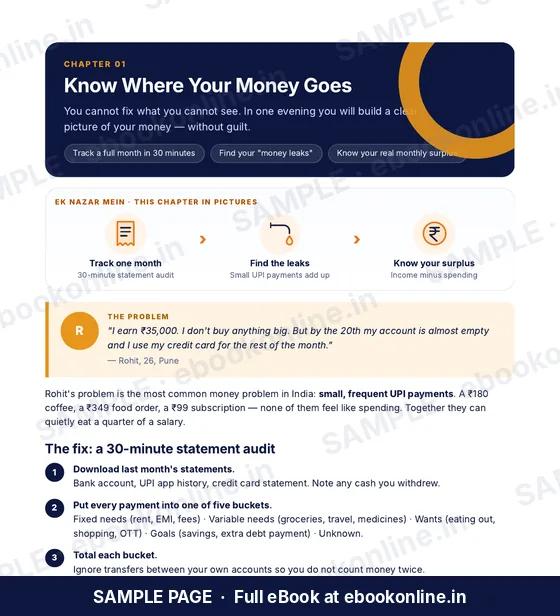
A look inside the eBook: 30 Days to Save Money Every Month
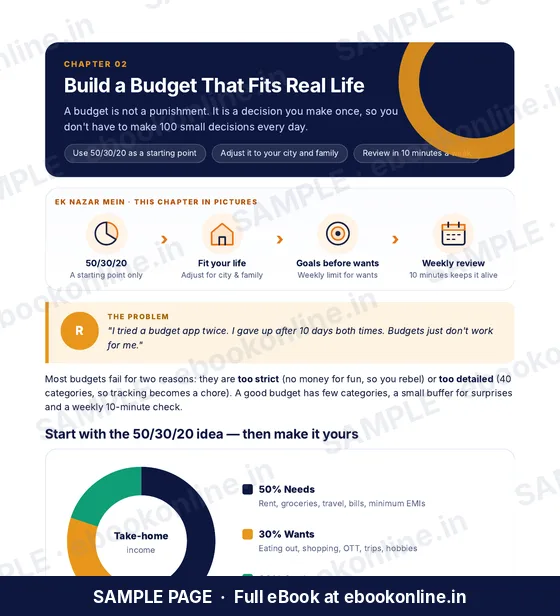
This article covers the basics. The full eBook goes step by step – these are real sample pages from the 35-page PDF. Tap any page to see it bigger.


What you get for ₹99
- 10 chapters: budget, emergency fund and saving goals
- Getting out of costly debt and basic insurance
- Investing ideas without the hype
- Scam protection and money with irregular income
- 35-page PDF · read on phone or print at home · instant download after payment
Coming soon.
Frequently asked questions
How much emergency fund should I have?
A common rule is 3–6 months of essential expenses. Keep 6–12 months if your income is irregular or you are the only earner in the family.
Where should I keep my emergency fund in India?
Somewhere safe and quick to withdraw, such as a separate savings account or sweep-in FD. Many people keep one month in savings and the rest in FDs.
Should I invest my emergency fund in stocks?
No. Stocks can fall sharply when you need the money. An emergency fund should be safe and easy to access.
Is insurance needed if I have an emergency fund?
Yes. Health insurance covers large medical bills that an emergency fund usually can't. The fund covers smaller gaps.
How can I build an emergency fund on a small salary?
Start with a small target like ₹10,000, set a fixed auto-transfer on salary day and add bonuses or gifts to it.