- Home
- Free guides
- Business
How to Start a Tiffin Service from Home – Cost, Menu & First Customers
If you cook well, a tiffin service can be a simple business to start from your own kitchen. This guide explains how to start a tiffin service from home step by step – cost, menu, price and customers.
- Start with 5–10 customers you can reach easily – offices, PGs and hostels nearby.
- Fix a weekly menu and calculate cost per tiffin before setting the price.
- Get FSSAI registration and keep the kitchen and packing very clean.
Office workers, students in PGs, bachelors and elderly people all want one thing – fresh, home-style food every day. That demand is why a tiffin service is one of the most popular home businesses in India. If you already cook for your family, you have the main skill. This guide shows how to start a tiffin service from home in a planned way.
Is a tiffin service right for you?
A tiffin service suits you if:
- You enjoy cooking and can cook the same quality every day.
- You can give 4–6 hours daily, mostly in the morning.
- Your family is fine with extra cooking in the kitchen.
- There are offices, colleges, PGs or hostels near you.
It needs consistency more than fancy recipes. Customers stay when the food is tasty, clean and on time – every single day.
Write down your cost for one full tiffin today: rotis, sabzi, dal, rice, salad, box and gas. That number is the base of your pricing.
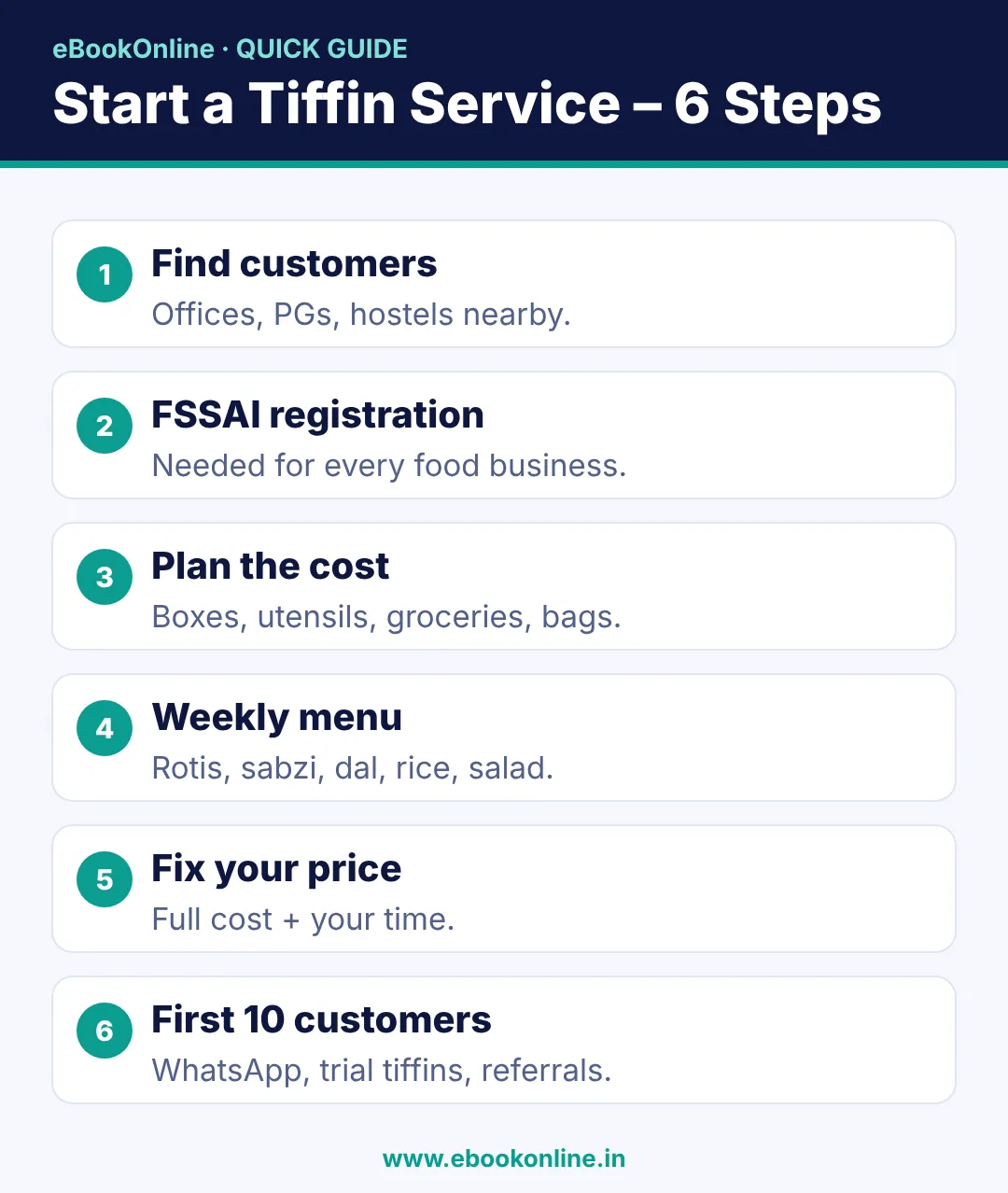
How to start a tiffin service from home: 8 steps
Step 1: Find your customers
Pick one group first: office staff, students, bachelors or senior citizens. Walk around your area and note offices, coaching centres and PGs within 2–3 km. Ask a few people what they eat now and what they pay.
Step 2: Check rules and registration
Every food business in India needs FSSAI registration or a licence, depending on size. Small home kitchens usually start with basic registration. Apply and check the latest rules on the official FSSAI (FoSCoS) portal. Also check if your housing society has any rules about home businesses.
Step 3: Plan the starting cost
| Item | Approx. cost |
|---|---|
| Tiffin boxes or disposable containers (first lot) | ₹2,000–5,000 |
| Extra utensils (big kadai, pressure cooker) | ₹2,000–5,000 |
| Groceries for the first week | ₹2,000–4,000 |
| Delivery bags | ₹500–1,000 |
| Printing menu cards / WhatsApp setup | ₹0–500 |
| Total small start | ₹6,500–15,500 |
These are rough estimates for a small start of 10–15 tiffins a day and will vary by city.
Step 4: Make a weekly menu
A fixed weekly menu makes shopping and cooking easy. A basic veg tiffin has 4 rotis, 1 sabzi, 1 dal, rice and salad or pickle.
| Day | Sabzi | Dal / Curry |
|---|---|---|
| Monday | Aloo gobhi | Dal tadka |
| Tuesday | Bhindi | Rajma |
| Wednesday | Mix veg | Moong dal |
| Thursday | Lauki chana | Kadhi |
| Friday | Paneer bhurji | Masoor dal |
| Saturday | Chole | Jeera rice special |
| Sunday | Special: pulao / puri-sabzi | Raita |
For more menu ideas, see 30 tiffin ideas for kids and office and the budget meal plan for India.
Step 5: Fix your price per tiffin
Add up the cost of one tiffin: grocery, gas, container, delivery. Then add a fair amount for your time and effort. Check what other tiffin services in your area charge, and stay close to that range. Offer a monthly plan (for example 22 or 26 days) at a small discount, because monthly customers give steady orders.
Step 6: Packing and hygiene
- Use food-grade containers that don't leak.
- Wear a cap or tie your hair while cooking, and keep nails short.
- Use fresh vegetables daily – never send leftovers.
- Label each tiffin with the customer's name if you deliver many.
Clean, neat packing is the cheapest marketing you can do.
Step 7: Delivery
Start with customers near you so you can deliver yourself or with a family member. As orders grow, hire a local delivery person for fixed hours. Always deliver on time – lunch at 1:30 when promised at 1:00 loses customers.
Step 8: Get your first 10 customers
- Make a WhatsApp Business profile with photos of real tiffins, menu and price.
- Share in society, office and PG WhatsApp groups (with permission).
- Offer a 1-day trial tiffin at a small price.
- Put a small notice at nearby PGs, gyms and coaching centres.
- Ask every happy customer to refer one friend.
Simple record keeping
Write every expense and payment in a notebook or Excel sheet. At the end of each week, check: total sales – total cost = your real profit. If profit is low, check waste, portion size and price.
Common mistakes to avoid
- Starting with too many dishes – keep the menu simple.
- Changing taste and quantity from day to day.
- Taking too many orders in the first week.
- Forgetting FSSAI registration.
- Giving long credit; take monthly plans in advance.
Once your tiffin runs well, you can add breakfast, diet tiffins or festival specials. For more home business options, read small business ideas from home.
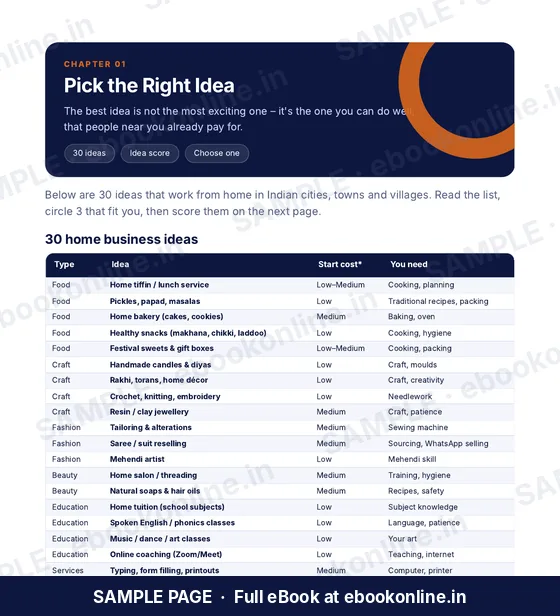
A look inside the eBook: 30 Low-Investment Business Ideas from Home
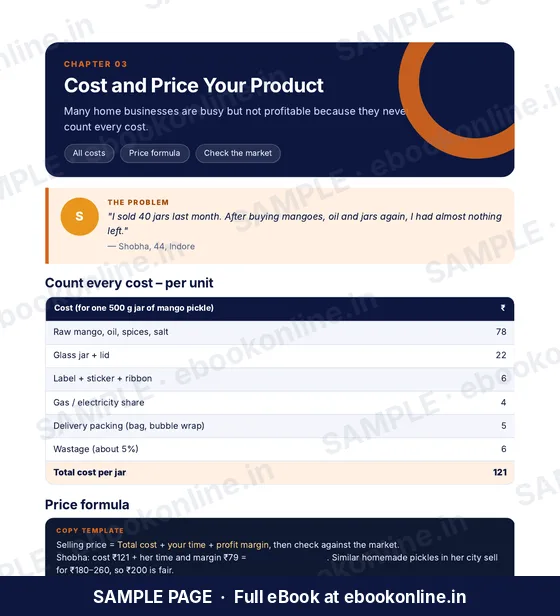
This article covers the basics. The full eBook goes step by step – these are real sample pages from the 21-page PDF. Tap any page to see it bigger.


What you get for ₹99
- 30 home business ideas
- Costing & pricing sheet
- 30-day launch plan
- Pick the Right Idea – 30 ideas and how to choose.
- Test Before You Invest – Small paid batches and pre-orders.
- 21-page PDF · read on phone or print at home · instant download after payment
Coming soon.
Frequently asked questions
How much money do I need to start a tiffin service from home?
A small start for 10–15 tiffins a day can begin at roughly ₹6,500–15,500 for boxes, utensils, groceries and delivery bags. Costs vary by city.
Is FSSAI registration required for a home tiffin service?
Yes, every food business in India needs FSSAI registration or a licence. Small home kitchens usually start with basic registration. Check foscos.fssai.gov.in.
How should I price my tiffin?
Calculate the full cost of one tiffin, add a fair amount for your time, and compare with other tiffin services nearby. Offer monthly plans for steady orders.
What should a basic tiffin include?
A simple veg tiffin usually has 4 rotis, 1 sabzi, 1 dal, rice and salad or pickle. Keep a fixed weekly menu.
How do I find customers for my tiffin service?
Start with offices, PGs, hostels and coaching centres near you. Use WhatsApp Business, society groups, trial tiffins and referrals.